Cutting Equipment Buying Guide: How to Choose the Right One
Table of Contents
Introduction
The Growing Demand for Precision Cutting
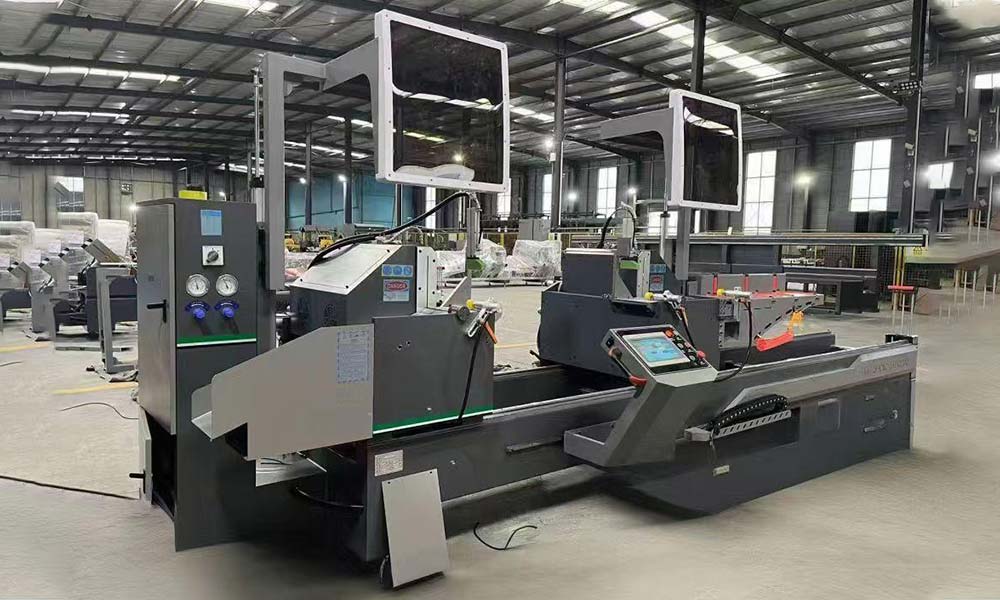
Modern manufacturing has evolved dramatically over the past decade, with precision cutting becoming increasingly critical across multiple industries. The demand for aluminum doors, windows, and curtain walls has surged, particularly in the construction and architectural sectors, requiring manufacturers to meet strict tolerances and quality standards. According to industry research reports, the global metal cutting tools market is projected to grow at a compound annual growth rate of 6.5% through 2030, driven primarily by the expansion of the construction and automotive industries.
When you consider the intricacies involved in producing aluminum profiles for high-end applications, the importance of selecting appropriate cutting equipment becomes immediately apparent. Modern architectural projects demand tolerances within 0.1mm to ensure proper fit and finish. Even minor deviations can lead to significant problems during installation, resulting in costly rework and material waste. The increasing complexity of contemporary designs, with curved surfaces and custom configurations, further amplifies the need for specialized cutting solutions.
Common Problems When Choosing Cutting Equipment
Many manufacturers face challenges when selecting cutting equipment, often resulting in operational inefficiencies and increased costs. One of the most prevalent issues involves choosing the wrong machine type for specific applications. For instance, using a manual cutting machine for high-volume production can severely limit throughput and increase labor costs. Data from manufacturing efficiency studies shows that improper equipment selection can reduce production efficiency by up to 40% while simultaneously increasing material waste by approximately 25%.
Another common problem stems from underestimating precision requirements. When equipment with insufficient accuracy is used for high-end projects, the cumulative error across multiple cuts can compromise the entire assembly process. This not only leads to material waste but also damages your reputation with clients who demand exacting standards. Furthermore, many buyers overlook the importance of scalability, selecting equipment that cannot accommodate future business growth or evolving product requirements. This shortsighted approach often necessitates premature equipment replacement, representing a significant financial burden.
What Is Cutting Equipment? A Complete Overview
Definition of Cutting Equipment
Cutting equipment encompasses a broad category of industrial machinery specifically engineered to partition various materials with precision and efficiency. These machines are designed to process materials including aluminum alloys, copper profiles, steel, and composite materials, serving diverse industries ranging from construction and automotive to aerospace and general manufacturing. The fundamental purpose of cutting equipment is to transform raw materials into precise components ready for further processing or assembly.
Advanced cutting equipment has evolved significantly from manual operations to sophisticated computer-controlled systems. Modern machines incorporate complex mechanical systems, digital controls, and automation features that enable manufacturers to achieve levels of precision and productivity that were previously unattainable. The integration of CNC technology has particularly revolutionized the cutting industry, enabling consistent accuracy across high-volume production runs while reducing operator dependency.
Main Types of Cutting Equipment
The landscape of cutting equipment can be categorized into three primary classifications based on their operational characteristics and automation levels. Manual cutting machines represent the most basic category, requiring direct operator intervention for positioning, cutting cycles, and material handling. These machines typically serve smaller operations with limited production volumes and modest precision requirements. While they offer lower initial investment, manual machines demand skilled operators and often result in variable output quality depending on human factors.
CNC cutting equipment represents the intermediate and advanced tier, incorporating computer numerical control systems that automate cutting operations with exceptional precision. These machines can execute complex cutting patterns automatically, maintain consistent quality across production batches, and significantly reduce operator dependency. According to manufacturing technology surveys, CNC equipment typically improves precision by 80-90% compared to manual alternatives while increasing production throughput by 50-200% depending on the application.
Automated production line systems constitute the most sophisticated category, integrating cutting equipment with material handling, sorting, and quality inspection systems in fully automated workflows. These solutions are designed for high-volume manufacturing environments where consistency, speed, and labor optimization are paramount. Industry data indicates that fully automated cutting systems can reduce labor costs by 60-75% while maintaining virtually uninterrupted production cycles, making them ideal for large-scale operations.
Key Factors to Consider When Choosing Cutting Equipment
Material Type Compatibility
One of the most critical considerations when selecting cutting equipment is its compatibility with the materials you intend to process. Different materials possess distinct physical properties that require specific cutting approaches. Aluminum profiles, for instance, generate significant heat during cutting and can deform if not properly supported and cooled. The equipment must provide adequate clamping systems and appropriate cutting speeds to maintain dimensional accuracy.
Copper pipes present different challenges due to their malleability and tendency to work-harden during cutting. The machine must incorporate appropriate blade specifications and feed mechanisms to prevent material deformation while maintaining clean cuts. Curtain wall materials, particularly those involving composite structures or protective coatings, demand specialized cutting approaches to prevent delamination or surface damage.
Beyond basic material compatibility, you must also consider the variety of materials your operations may encounter. Versatile cutting equipment that can handle multiple material types without extensive changeover provides greater flexibility and reduces the need for multiple specialized machines. This versatility becomes increasingly valuable as your product line expands or market demands shift.
Cutting Accuracy Requirements
Precision requirements vary dramatically across different applications and industries. Standard door and window production may tolerate deviations of 0.2-0.3mm without significant functional consequences. However, high-end architectural applications, particularly those involving complex assemblies or exposed visible joints, often demand precision within 0.1mm to ensure proper fit and aesthetic quality.
The significance of CNC systems in achieving precise cuts cannot be overstated. Computer-controlled positioning systems eliminate human error and ensure consistent accuracy across thousands of cuts. According to quality control studies, CNC cutting equipment typically maintains precision within 0.05-0.1mm compared to 0.2-0.5mm for manual equipment. This difference becomes particularly critical when cumulative errors across multiple components must align perfectly during final assembly.
When evaluating accuracy claims, consider both short-term consistency and long-term stability. Many machines can achieve acceptable precision initially but may drift over time due to wear, thermal expansion, or mechanical degradation. Equipment featuring robust construction, quality components, and regular maintenance requirements will maintain accuracy throughout its operational lifespan, providing better long-term value.
Production Volume
Your production volume significantly influences the appropriate cutting equipment selection. Small workshops with daily production of less than 50 windows or similar quantities may find manual or semi-automatic equipment sufficient. These operations benefit from lower initial investment and simpler operation, though they must accept higher labor requirements and potentially slower throughput.
Medium-sized factories producing 50-200 units daily typically benefit from CNC equipment that balances automation investment with production efficiency. At this scale, the labor savings and quality consistency of CNC equipment often justify the higher initial cost through reduced operational expenses and improved competitiveness.
Large manufacturing plants producing over 200 units daily require fully automated cutting systems to maintain profitability. At these volumes, manual and semi-automatic equipment becomes prohibitively expensive in terms of labor costs and throughput limitations. Automated systems, despite their substantial initial investment, typically achieve return on investment within 2-3 years through dramatic labor reduction and continuous operation capabilities.
Automation Level
The automation spectrum ranges from fully manual operation to completely autonomous cutting systems. Manual equipment requires constant operator involvement, including material loading, positioning, cutting cycle initiation, and unloading. While these machines offer the lowest purchase price, they demand skilled operators and result in variable output quality depending on human factors.
Semi-automatic equipment incorporates automated positioning or cutting cycles while still requiring manual material handling. These machines represent an intermediate solution, providing improved consistency and reduced operator dependency compared to fully manual options while maintaining lower costs than fully automated systems.
Fully automated cutting systems integrate robotic material handling, automatic positioning, cutting cycles, and unloading operations. These systems can operate with minimal human intervention, dramatically reducing labor costs while maximizing consistency and throughput. However, the substantial initial investment and technical requirements necessitate careful consideration of production volume and technical capabilities.
Types of Cutting Equipment for Aluminum Profiles
Double Head Cutting Equipment
Aluminum Profile CNC Double Head Precision Cutting Saw
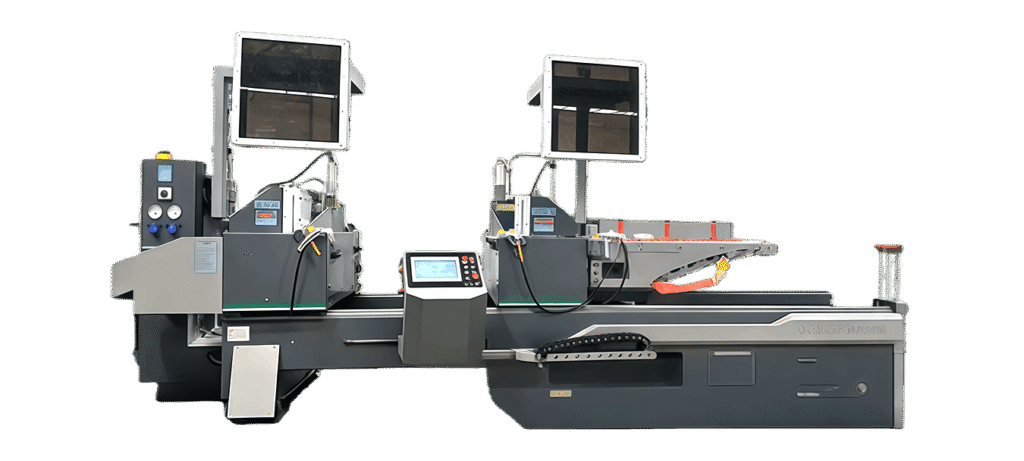
This machine represents a versatile solution for modern aluminum processing operations. The dual-head design enables flexible 45-degree and 90-degree cutting configurations, accommodating diverse production requirements without extensive changeover. Both saw heads can freely switch between angles, providing exceptional versatility for mixed production runs involving various window and door styles.
The machine features rectangular guide pairs for feed motion, while the machine bed employs rectangular guide motion pairs. The saw head feed motion also utilizes rectangular guide pairs, ensuring high movement precision and accuracy for cut components. Hydraulic damping cylinders enable uniform feed speed adjustment and stable saw blade cutting performance. The machine supports both ultra-long material cutting with unlimited length and ultra-short material cutting capabilities, along with material arrangement processing lists.
For enhanced functionality, the machine offers optional marking features that print dimensions on profile surfaces during cutting, effectively preventing worker marking errors. Maintenance is facilitated through lubrication devices installed on guides, bearings, and other transmission components. The CNC system enables precise and reliable positioning, automatic processing of short materials, and list-style processing functions, significantly improving production efficiency.
Aluminum Profile Double-Head Precision Cutting Saw
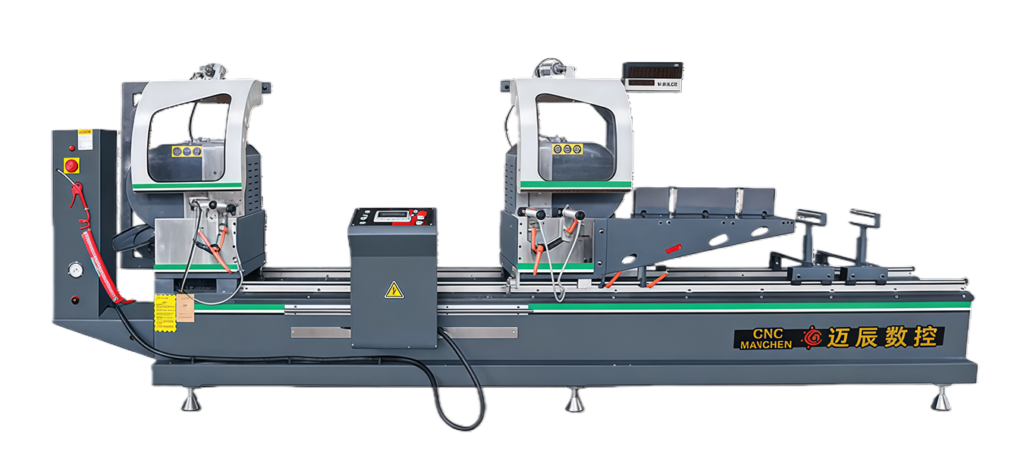
Designed for cost-effective operation in standard door and window production environments, this machine provides reliable performance without the complexity of full CNC integration. Both saw heads can freely switch between 45-degree and 90-degree angles, offering flexibility for various production requirements. The feed motion guides utilize imported linear guides, ensuring smooth operation and consistent precision.
The machine bed employs linear guide motion pairs, guaranteeing higher movement precision and cutting component accuracy. Hydraulic damping cylinders provide uniform feed speed adjustment and stable saw blade cutting performance. For operator safety and convenience, automatically opening and closing protective covers are incorporated, protecting operators from debris while facilitating easy material access.
This equipment represents an ideal choice for manufacturers seeking a balance between capability and investment. While not as feature-rich as its CNC counterpart, the machine delivers reliable performance for standard applications with lower initial costs and simpler operation requirements, making it particularly suitable for growing operations with moderate production volumes.
Fixed Angle Cutting Equipment
Aluminum Profile CNC Double-End Fixed 45° Cutting Saw
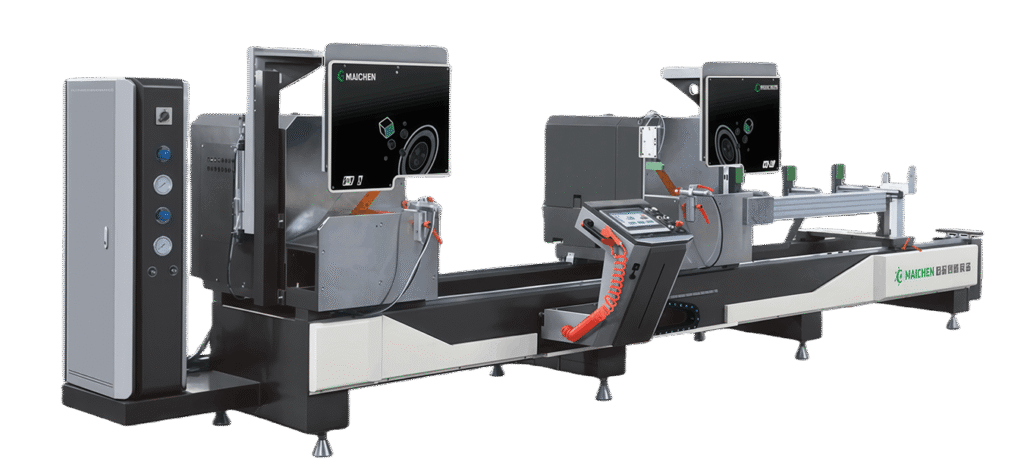
This specialized machine addresses the critical need for precise 45-degree cuts in aluminum door, window, and curtain wall profile processing. By fixing both saw heads at the 45-degree cutting angle, the machine eliminates errors caused by swing adjustments during angle changes, significantly improving both efficiency and precision. This fixed configuration is particularly advantageous for operations focusing on standard frame assemblies where consistent 45-degree cuts comprise the majority of production.
The machine design incorporates several advanced features contributing to precision and durability. Both left and right sides are equipped with inclined clamping hydraulic cylinders that effectively prevent material displacement during cutting operations. This stability not only improves cutting accuracy but also extends saw blade life by reducing vibration and uneven cutting forces. The adoption of imported spindle motors ensures high-precision cutting performance, while hydraulic damping cylinders guarantee smooth feed speed adjustment and stable cutting performance.
Material handling efficiency is enhanced through dual lifting supports at the middle and tail sections, eliminating the need for manual material support stands. This feature improves both convenience and speed during operation, allowing operators to focus on material loading and unloading rather than supporting materials during cutting. The machine represents an ideal solution for high-efficiency batch production where standard 45-degree cuts dominate production requirements.
Multi-Head Cutting Equipment
CNC Three-Head Cutting Saw for Sliding Doors
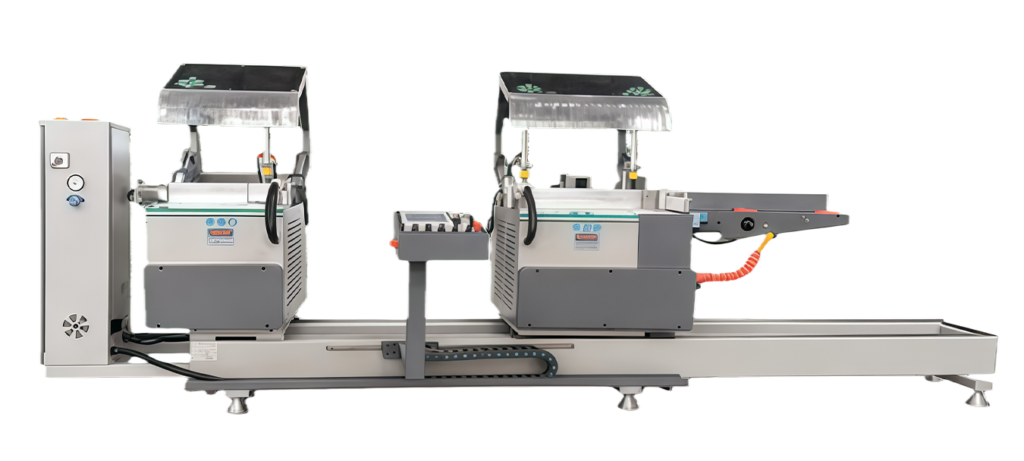
This machine represents a specialized solution designed primarily for cutting sliding door profiles while also accommodating aluminum door, window, and curtain wall profiles. The three-saw head configuration includes two 45-degree saw heads and one 90-degree saw head, enabling efficient production of complete sliding door assemblies without requiring multiple machines or extensive changeover procedures.
The feed motion employs an oil-gas hybrid system that ensures cutting stability and superior cutting results. This innovative approach combines the smooth motion characteristics of pneumatic systems with the force control capabilities of hydraulic systems, resulting in consistently clean cuts across various material types and dimensions. The machine bed utilizes linear guide motion pairs, while the saw head feed motion employs rectangular guide pairs and spindle motors, providing higher movement precision and guaranteeing cut component accuracy.
A particularly valuable feature of this machine is its exceptional versatility, with 95% of sliding door profiles equipped with material back plates that eliminate the need for custom buffer molds. This universal compatibility provides stronger versatility, more convenient operation, and higher efficiency. The machine enables manufacturers to handle diverse sliding door profiles without extensive tooling changes, dramatically improving production flexibility and reducing setup times.
Curve and Special Cutting Equipment
Aluminum Profile Curve CNC Precision Cutting Saw Machine
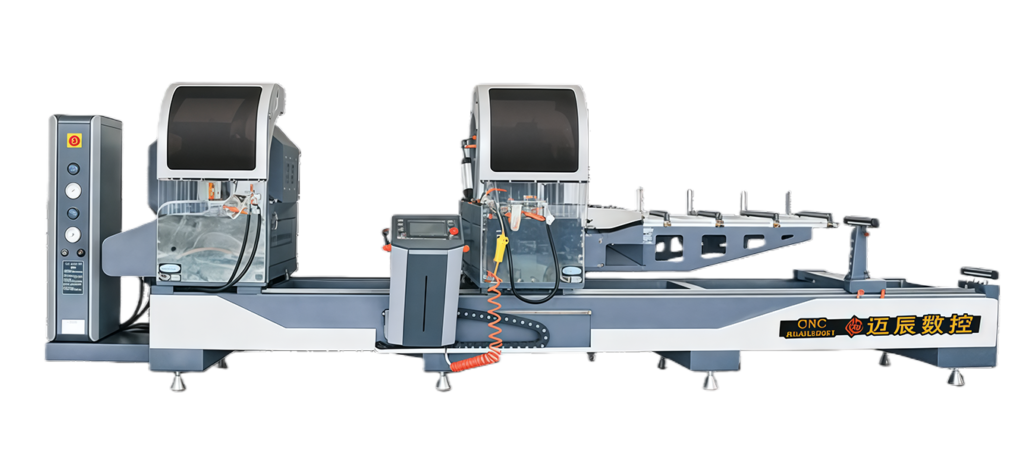
Curved aluminum profiles present unique cutting challenges that conventional equipment cannot address effectively. This specialized machine features a saw blade that moves along an arc cutting path, always ensuring the optimal cutting angle relative to the material surface. This approach improves saw blade durability while significantly enhancing cutting surface smoothness, which is critical for curved applications where surface finish is particularly visible.
The machine is specifically designed for cutting aluminum door, window, and curtain wall profiles with curved configurations. It incorporates automatic size setting, precise positioning, and user-friendly operation characteristics. Both saw heads can freely switch between 45-degree and 90-degree angles, accommodating various curved profile applications. The feed motion guides employ imported linear guides, while the machine bed uses linear guide motion pairs. The saw head feed motion utilizes rectangular guide pairs, ensuring high movement precision and cutting accuracy.
Hydraulic damping cylinders enable uniform feed speed adjustment and stable saw blade cutting performance. The machine adopts an added heavy-duty mechanical structure frame, providing higher stability, higher saw cutting precision, and longer service life. It supports ultra-long material cutting with unlimited length and ultra-short material cutting within 400mm, along with material arrangement processing lists. A material height measurement feature enables one-touch automatic measurement of profile height, automatically importing the height to improve work efficiency. The imported high-speed electric spindle offers high precision, high rotation speed, low noise, and excellent stability.
Curve cutting capabilities are increasingly valuable in contemporary architecture, where curved designs create distinctive aesthetic statements. This machine enables manufacturers to address this growing market segment while maintaining the precision and efficiency demanded by professional applications.
Specialized Cutting Equipment
Automatic Aluminum Corner Connector Cutting Saw
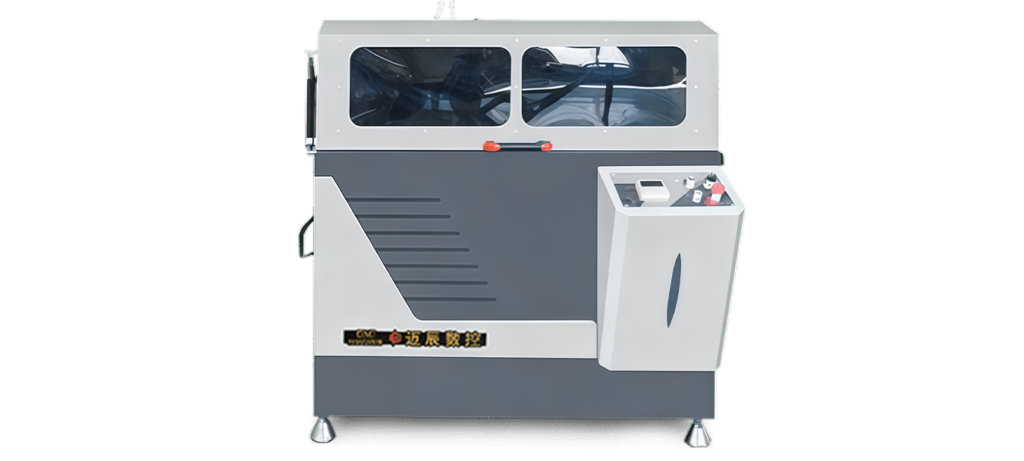
Corner connectors represent critical components in aluminum door and window assemblies, requiring precise cutting for proper fit and structural integrity. This specialized machine is designed specifically for cutting aluminum door and window corner brace profiles. Automatic feeding controlled by PLC ensures stable and efficient operation, making it particularly suitable for mass production environments where consistency and throughput are paramount.
The machine incorporates an automatic counting system that records cutting times, facilitating convenient batch processing and production tracking. This feature simplifies quality control and enables accurate production planning by providing real-time data on completed units. The adoption of imported hard alloy saw blades provides high processing precision and exceptional durability, reducing tool replacement frequency and maintaining consistent cut quality over extended production runs.
The machine characteristics include simple operation, reliable performance, advanced technology, and easy maintenance. These attributes contribute to reduced operator training requirements, minimal downtime, and lower long-term ownership costs. For manufacturers specializing in aluminum door and window production, this specialized equipment represents a valuable addition to the production line, enabling efficient corner connector production while maintaining the precision required for quality assemblies.
CNC Glazing Bead Saw with Wireless Measurement System
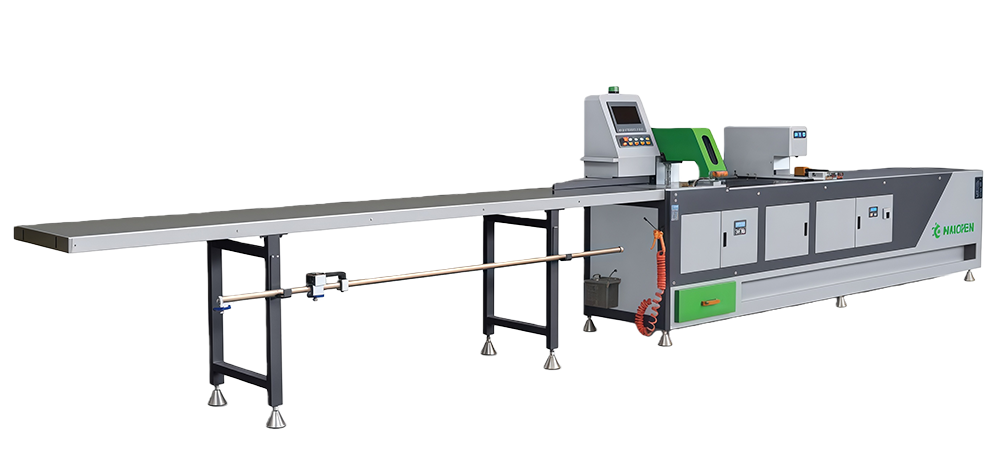
Glazing beads represent particularly challenging components due to their small dimensions and the precision required for proper fit. This advanced machine incorporates several innovative features that address these challenges while significantly improving operational efficiency. The worktable unit adopts an integrated design combining the saw cutting unit and CNC length setting unit, providing mechanical structural stability, simple operation, and reliable precision.
The wireless measurement unit employs high-precision wireless calipers with measurement length errors not exceeding 0.1mm and Bluetooth transmission range of at least 100 meters. This wireless approach eliminates cable constraints while maintaining exceptional measurement accuracy, enabling operators to measure materials remotely and transmit data to the cutting system for automated positioning. The transmission system unit utilizes embedded CNC processing technology, directly processing guide rail slots, rack slots, and magnetic ruler slots on the worktable, ensuring all components remain mutually parallel and perpendicular, thereby dramatically improving assembly accuracy and eliminating assembly errors.
Dual guide rail motion and ground racks ensure the CNC length setting unit operates more smoothly under high-speed conditions while providing higher positioning accuracy. The positioning unit combines a 750W high-precision servo motor with a magnetic ruler, achieving positioning accuracy within 0.1mm. The operating system unit utilizes independently developed software with a 10-inch touch screen interface. Stored data can be wirelessly read cyclically, and the simple and user-friendly interface supports size transmission and simultaneous positioning/cutting without interference, significantly improving processing efficiency.
Advanced Cutting Equipment for High-End Manufacturing
Integrated CNC Precision Cutting Saw
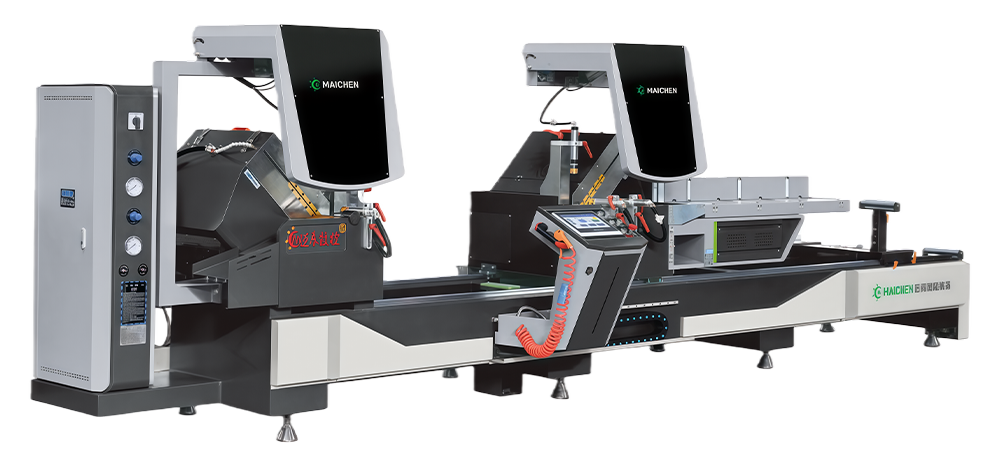
High-end manufacturing demands equipment that combines precision, durability, and advanced features to meet exacting quality standards. This integrated machine features a one-piece cast saw head design. The support plate, front and rear plates, and reinforcing beams all feature a one-piece structure that prevents later deformation and improves stability. The front and rear rotating center holes are processed simultaneously, ensuring concentricity and guaranteeing saw head rotation precision.
The machine is designed for cutting aluminum door, window, and curtain wall profiles. Both saw heads can freely switch between 45-degree and 90-degree angles. The feed motion guides employ imported linear guides, while the machine bed uses linear guide motion pairs. The saw head feed motion utilizes rectangular guide pairs, ensuring high movement precision and cutting accuracy. Hydraulic damping cylinders provide uniform feed speed adjustment and stable saw blade cutting performance.
For operator safety and convenience, automatically opening and closing protective covers are incorporated. The machine employs CNC technology enabling it to cut profiles of various specifications and dimensions. This versatility, combined with its one-piece construction that prevents deformation and maintains long-term accuracy, makes it particularly suitable for high-end applications where consistency and reliability are non-negotiable.
Heavy-Duty Internal Swing Precision Cutting Saw
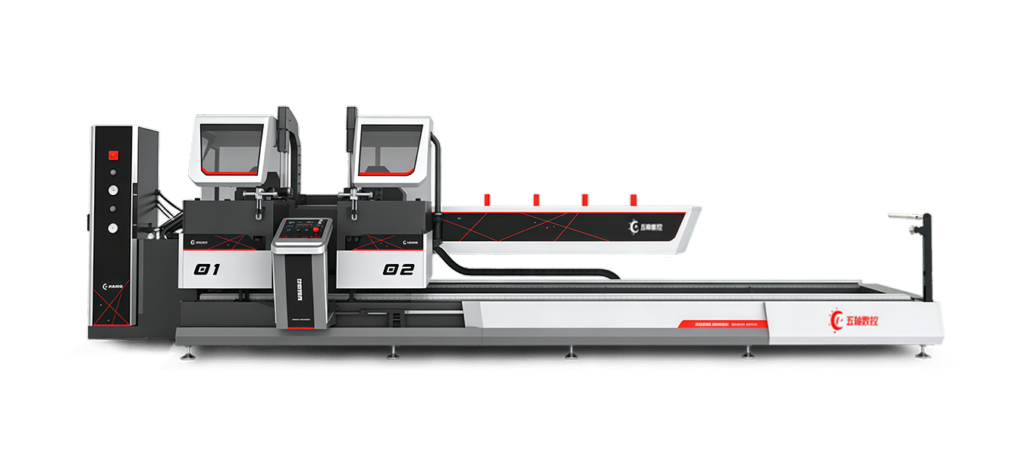
System doors and engineering projects present unique challenges that demand robust, high-capacity cutting equipment. This heavy-duty machine is specifically designed for cutting aluminum door, window, and curtain wall profiles, with particular emphasis on system doors and engineering door applications. Both saw heads can switch between 45-degree and 90-degree angles, making them more suitable for processing system doors and engineering doors.
The machine bed employs linear guide motion pairs, while the saw head feed motion uses rectangular guide pairs, guaranteeing high movement precision and cut component accuracy. The machine features a 6mm square pipe welded frame and one-piece cast saw head, ensuring machine precision and durability. Internal 45-degree cutting requires no additional material height support, while the ultra-wide cutting range includes short minimum cutting distances. The new appearance design incorporates advanced CNC systems, Airtac pneumatic components, and Schneider electrical components, dramatically improving machine stability.
This heavy-duty construction ensures consistent precision even under demanding production conditions. The internal swing mechanism provides enhanced cutting capabilities for thick profiles and complex geometries that might challenge lighter-duty equipment. For manufacturers serving the commercial construction and high-end residential markets, this machine provides the combination of precision, capacity, and durability required for demanding applications.
CNC Cutting Equipment vs Traditional Machines
Key Differences
Understanding the fundamental differences between traditional cutting equipment and CNC alternatives is essential for making informed purchasing decisions. Traditional cutting equipment relies primarily on manual positioning and operation, with precision heavily dependent on operator skill and consistency. These machines typically offer lower initial investment but incur higher ongoing labor costs and variable output quality. Precision levels generally range from 0.2mm to 0.5mm depending on operator skill and machine condition.
CNC cutting equipment incorporates computer numerical control systems that automate positioning and cutting operations with exceptional precision. These machines typically achieve accuracy within 0.05mm to 0.1mm, representing a 400-800% improvement over manual alternatives. While CNC equipment requires higher initial investment, the labor savings and quality consistency often justify the cost through reduced operational expenses and improved competitiveness.
The table below highlights the key differences between traditional cutting equipment and CNC alternatives across critical performance dimensions:
| Performance Dimension | Traditional Cutting Equipment | CNC Cutting Equipment |
|---|---|---|
| Precision | Low (0.2-0.5mm) | High (±0.1mm) |
| Production Efficiency | Moderate, operator-dependent | High, automated operation |
| Labor Cost | High, requires skilled operators | Low, minimal operator intervention |
| Automation Level | Low, manual operation required | High, programmable automation |
| Consistency | Variable, depends on operator | Consistent, automated precision |
| Setup Time | Minimal, but requires operator adjustment | Initial programming, then automated |
| Changeover Time | Fast but manual | Automated via programming |
| Throughput | Limited by operator speed | Limited by machine cycle time |
| Material Waste | Higher due to less precise cutting | Lower due to improved accuracy |
| Quality Control | Requires frequent inspection | Built-in precision consistency |
| Scalability | Limited by labor availability | Enhanced by automation |
| Initial Investment | Lower purchase price | Higher purchase price |
| Operating Cost | Higher labor costs | Lower labor costs |
| Return on Investment | Slower due to higher operating costs | Faster due to efficiency gains |
Which One Should You Choose?
The choice between traditional cutting equipment and CNC alternatives depends primarily on your production volume, precision requirements, and long-term business objectives. For small workshops with limited production volumes and modest precision requirements, basic manual or semi-automatic equipment often provides sufficient capability with lower initial investment. These operations typically produce less than 50 units daily and serve local markets with standard quality expectations.
Medium factories producing between 50-200 units daily generally benefit from CNC equipment that balances automation investment with production efficiency. At this scale, the labor savings and quality consistency of CNC equipment often justify the higher initial cost through reduced operational expenses and improved competitiveness. These operations typically serve broader markets with more demanding quality requirements and benefit from the flexibility and precision that CNC equipment provides.
Large manufacturing plants producing over 200 units daily require CNC intelligent equipment to maintain profitability and competitiveness. At these volumes, manual and semi-automatic equipment becomes prohibitively expensive in terms of labor costs and throughput limitations. Automated CNC systems, despite their substantial initial investment, typically achieve return on investment within 2-3 years through dramatic labor reduction and continuous operation capabilities. These operations often serve national or international markets with exacting quality standards that demand the precision and consistency of CNC technology.
How to Match Cutting Equipment with Your Production Needs
For Small Workshops
Small workshops typically face budget constraints while needing to maintain competitiveness in local markets. For these operations, cost-effective double-head saws often provide the best balance of capability and investment. Manual or semi-automatic double-head cutting machines can handle diverse production requirements while requiring lower initial investment and simpler operation. These machines typically feature both 45-degree and 90-degree cutting capabilities, enabling production of standard door and window assemblies without extensive changeover.
When selecting equipment for small workshops, prioritize versatility and ease of operation over automation features. Simple, reliable machines that can handle diverse production requirements provide greater value than highly automated systems that require technical expertise to maintain and operate. Consider equipment that can grow with your business, offering upgrade paths or compatibility with future automation investments as your production volumes increase.
For Medium Factories
Medium-sized factories producing moderate volumes benefit from CNC precision cutting machines that provide enhanced consistency and reduced operator dependency. At this scale, the quality consistency and labor savings of CNC equipment justify the higher initial investment. Look for CNC double-head cutting machines with programmable features that enable rapid changeover between different product types while maintaining consistent precision across production batches.
Consider equipment that balances automation investment with operational complexity. Fully automated systems may represent overinvestment for moderate volumes, while manual equipment limits throughput and consistency. CNC machines with semi-automatic material handling and automated cutting cycles often provide the optimal balance, improving precision and reducing operator fatigue without requiring extensive technical infrastructure.
For Large Manufacturing Plants
Large manufacturing plants require multi-head and automated cutting systems to maintain throughput, consistency, and competitiveness. At this scale, labor costs become the dominant operational expense, and automation becomes essential for profitability. Look for integrated cutting systems that incorporate robotic material handling, automatic positioning, cutting cycles, and quality inspection functions in continuous workflows.
Consider equipment that offers high-speed operation, minimal changeover requirements, and integration with broader manufacturing systems including inventory management and quality control. The initial investment in advanced automated cutting systems is justified through dramatically reduced labor costs, virtually continuous operation, and the ability to compete in high-volume markets with demanding quality requirements.
Cutting Equipment Maintenance and Lifespan Tips
Daily Maintenance Checklist
Proper maintenance extends equipment lifespan, maintains precision, and reduces unexpected downtime. Daily maintenance routines should include lubrication system inspection to ensure adequate lubrication of all moving components. Inspect oil levels in hydraulic systems and top up as needed with recommended lubricants. Check pneumatic systems for air leaks and ensure proper pressure settings are maintained.
Blade inspection represents another critical daily maintenance task. Examine cutting blades for wear, damage, or dullness that could affect cut quality or pose safety risks. Replace blades according to manufacturer specifications or when cut quality deteriorates beyond acceptable tolerances. Clean blade surfaces and ensure proper mounting torque is maintained.
Check clamping mechanisms for proper operation and wear. Inspect hydraulic cylinders, pneumatic clamps, and mechanical fixtures for consistent pressure and secure material holding. Verify that safety interlocks and emergency stops function correctly, and that protective guards are in place and operational.
How to Extend Machine Lifespan
Beyond daily maintenance, several practices significantly extend cutting equipment lifespan and maintain precision over years of operation. Use high-quality components including replacement blades, bearings, and wear parts from reputable suppliers. Inferior components may offer immediate cost savings but often result in reduced precision, increased maintenance requirements, and premature equipment failure.
Regular calibration ensures that precision systems maintain their accuracy over time. Follow manufacturer recommendations for calibration intervals, typically ranging from monthly to annually depending on usage intensity and accuracy requirements. Document calibration results to track equipment performance and identify developing issues before they affect production quality.
Implement preventive maintenance schedules that address potential issues before they cause failures. Replace components according to usage metrics rather than waiting for failure, particularly for wear items such as bearings, seals, and electrical contacts. Train maintenance personnel on proper maintenance procedures and safety protocols to ensure maintenance activities improve rather than compromise equipment performance.
Environmental factors significantly impact equipment lifespan. Maintain appropriate operating temperatures, humidity levels, and cleanliness in cutting areas. Dust and debris can cause premature wear and precision degradation, while temperature fluctuations can affect dimensional stability. Establish proper ventilation and dust collection systems to maintain optimal operating conditions.
Common Mistakes When Buying Cutting Equipment
Ignoring Precision Requirements
One of the most frequent and costly mistakes involves underestimating precision requirements for your intended applications. Many buyers select equipment based on general cutting capability without considering the specific tolerances required by their products and markets. This approach often leads to equipment that cannot meet quality expectations, resulting in rework, waste, and reputation damage.
Before making purchasing decisions, thoroughly analyze the precision requirements across your product range. Consider not only immediate needs but also future product developments that may demand higher precision. Consult with customers and industry standards to understand the tolerances required for your target markets. Remember that equipment cannot be easily upgraded to achieve significantly higher precision, making initial selection critical for long-term capability.
Choosing Based on Price Only
Price represents only one component of total ownership cost, yet many buyers focus exclusively on initial purchase price without considering long-term operating costs. Lower-priced equipment often incurs higher maintenance requirements, shorter component lifespans, and greater labor costs, resulting in higher total cost of ownership over equipment lifespan.
Conduct comprehensive cost analysis that includes initial investment, maintenance costs, labor requirements, energy consumption, expected lifespan, and residual value. Consider productivity differences between alternatives, as equipment with higher initial investment often provides substantially higher throughput that justifies the cost through increased revenue capacity. Remember that the lowest price option rarely represents the best value when considering total cost of ownership.
Overlooking Future Expansion Needs
Equipment purchases should account for future business growth and evolving product requirements. Many buyers select equipment that meets immediate needs but cannot accommodate increased production volumes or new product types without substantial modification or replacement. This shortsighted approach often necessitates premature equipment replacement, representing significant financial loss.
Consider your business growth projections and diversification plans when selecting cutting equipment. Equipment that can be upgraded or expanded to meet increased demand provides better long-term value. Modular designs, CNC programmability, and automation upgrade paths enable equipment to evolve with your business rather than becoming obsolete. Consult with equipment suppliers about upgrade options and future capabilities before making purchasing decisions.
Conclusion
Key Takeaways
Selecting appropriate cutting equipment requires careful consideration of multiple factors beyond simple cutting capability. Your material types, precision requirements, production volumes, and automation needs should all inform equipment selection decisions. Remember that cutting equipment represents a long-term investment that will impact your production capabilities, product quality, and operational costs for years to come. The lowest price option rarely provides the best value when considering total cost of ownership, including maintenance, labor, productivity, and quality differences.
Match machine type with production needs by carefully analyzing your current requirements while accounting for future growth and diversification. Focus on precision, efficiency, and scalability rather than immediate cost savings. Equipment that can grow with your business through upgrades and expansion provides better long-term value than equipment that meets immediate needs but cannot accommodate future requirements. Remember that equipment capabilities determine your production possibilities, and choosing equipment that limits your potential represents a strategic error.
Final Recommendation
Invest in CNC and automated cutting equipment for long-term growth and competitiveness in the aluminum processing market. The manufacturing industry continues evolving toward higher precision, greater efficiency, and lower labor costs, making CNC technology increasingly essential for competitive operations. While the initial investment exceeds manual alternatives, the productivity improvements, quality consistency, and labor savings typically justify the cost through improved competitiveness and profitability.
Begin by thoroughly analyzing your production requirements, constraints, and growth projections. Consult with equipment suppliers who understand your industry and applications to identify solutions that address your specific needs. Consider total cost of ownership rather than initial investment alone, and select equipment that can evolve with your business through upgrades and expansion. Finally, invest in operator training and preventive maintenance programs to maximize equipment value and lifespan, ensuring your cutting equipment continues contributing to business success for years to come.
FAQ
What is the best cutting equipment for aluminum profiles?
The best cutting equipment for aluminum profiles depends on your specific production requirements, volume, and precision needs. For small operations with diverse production requirements, double-head cutting saws offering both 45-degree and 90-degree cutting capabilities provide excellent versatility. Medium to large operations benefit from CNC equipment that enhances precision and consistency while reducing operator dependency. Specialized applications such as curved profiles or sliding doors require purpose-designed equipment that addresses specific challenges. For high-volume production of standard profiles, fixed-angle equipment maximizes efficiency while maintaining precision.
What is the difference between CNC and manual cutting equipment?
The primary differences between CNC and manual cutting equipment involve precision, automation, and operational efficiency. CNC equipment incorporates computer numerical control systems that automate positioning and cutting operations with exceptional precision, typically achieving accuracy within 0.05mm to 0.1mm. Manual equipment relies on operator skill for positioning, typically achieving precision between 0.2mm and 0.5mm. CNC equipment reduces operator dependency and improves consistency across production batches while enabling programmable automation for unattended operation. Manual equipment requires lower initial investment but incurs higher labor costs and variable output quality. CNC equipment generally provides better long-term value for operations with consistent production volumes and quality requirements.
How to choose cutting equipment for a factory?
Selecting cutting equipment for a factory requires comprehensive analysis of production requirements, constraints, and objectives. Begin by documenting current production volumes, product mix, precision requirements, and labor resources. Project future growth and diversification plans to understand evolving needs. Consider total cost of ownership rather than initial investment alone, including maintenance, labor, energy, and productivity differences between alternatives. Evaluate equipment compatibility with existing systems and infrastructure, including power requirements, space availability, and integration with material handling systems. Finally, assess supplier capabilities including technical support, spare parts availability, and service responsiveness, as these factors significantly impact long-term equipment value.
Which cutting equipment offers the best ROI?
The cutting equipment offering the best return on investment depends on your specific operational context, including production volume, labor costs, precision requirements, and growth plans. For small operations with limited production volumes and modest precision requirements, manual or semi-automatic equipment often provides the best ROI due to lower initial investment and adequate capability. Medium operations with consistent production volumes typically achieve the best ROI with CNC equipment that balances automation investment with improved precision and reduced labor requirements. Large operations with high production volumes generally realize the best ROI from automated cutting systems that dramatically reduce labor costs while maximizing throughput. The key is matching equipment capabilities to your specific production requirements and conducting comprehensive total cost of ownership analysis rather than focusing exclusively on initial investment.