Heavy-Duty Synchronous Corner Crimping Machine: The Backbone of High-Strength Window Assembly
Table of Contents
Introduction
In aluminum door and window manufacturing, the corner connection is the most critical structural point. No matter how precise your cutting, milling, or profile design is, the final product strength ultimately depends on how well the corners are crimped.
Weak corner joints lead to air leakage, water infiltration, frame deformation, and long-term structural instability. This is why manufacturers are increasingly turning to the heavy-duty synchronous corner crimping machine, designed to ensure uniform force distribution and stable high-strength corner assembly.
Industry engineering insights show that corner assembly quality can influence up to 70% of the overall structural durability of aluminum window systems, especially in large-scale curtain wall and heavy-duty frame applications.
In this article, you will learn how synchronous crimping technology works, why heavy-duty systems matter, and how this machine transforms structural reliability in modern production lines.
What Is a Heavy-Duty Synchronous Corner Crimping Machine?
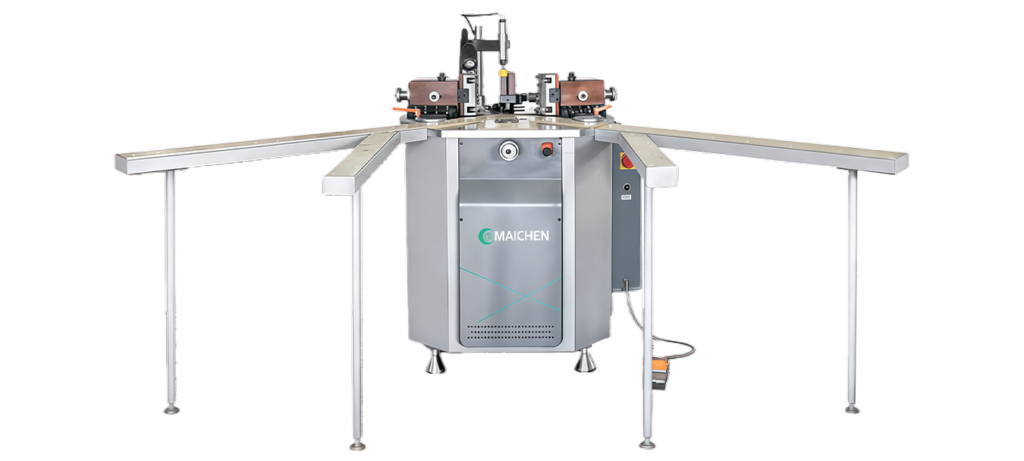
A heavy-duty synchronous corner crimping machine is a specialized hydraulic or servo-assisted system designed to assemble aluminum profile corners with high force accuracy and synchronized movement.
Its core function is to press corner connectors into aluminum profiles evenly from multiple directions, ensuring:
- Strong mechanical bonding
- Precise 90° corner formation
- Uniform pressure distribution
- Long-term structural stability
Unlike traditional corner crimping machines that apply force from a single direction, synchronous systems apply coordinated pressure from multiple crimping heads at the same time.
This synchronized action significantly improves joint consistency and reduces deformation risk.
Why Traditional Corner Crimping Methods Are No Longer Enough
Uneven Pressure Distribution
Single-point crimping often leads to weak or over-compressed areas.
Structural Misalignment
Inconsistent force causes slight angular deviations in frame assembly.
Limited Load Capacity
Conventional systems struggle with heavy-duty or large-profile systems.
High Dependence on Operator Skill
Manual adjustments introduce variability between batches.
As modern architectural systems become larger and more demanding, these limitations become critical failure points.
How Heavy-Duty Synchronous Corner Crimping Machine Technology Works
Multi-Point Synchronized Force Application
The machine uses multiple hydraulic cylinders that operate simultaneously to apply equal pressure on all sides of the corner joint.
Precision Positioning System
Profiles are aligned using mechanical guides to ensure exact 90° positioning before crimping begins.
Hydraulic Stability Control
Pressure is distributed evenly through a controlled hydraulic system to prevent deformation.
Structural Locking Mechanism
Once crimped, corner connectors are permanently locked into place with high mechanical strength.
Real Case: Improving Structural Stability in Large Window Frames
A fabrication workshop producing large aluminum window systems faced recurring issues with corner deformation after assembly. These problems included:
- Frame misalignment during installation
- Reduced air-tightness performance
- Rework due to weak corner joints
After adopting a heavy-duty synchronous corner crimping machine, improvements included:
- Significantly stronger corner bonding strength
- More consistent 90° frame accuracy
- Reduced deformation in large profiles
- Improved installation stability on site
The most important change was the elimination of uneven pressure during crimping.
Key Advantages of Heavy-Duty Synchronous Corner Crimping Machine
High Structural Strength
Synchronized pressure ensures maximum bonding strength at corner joints.
Perfect Angle Accuracy
Maintains consistent 90° angles across all production batches.
Suitable for Heavy Profiles
Designed for large and thick aluminum profiles used in modern architecture.
Reduced Rework Rate
Stable crimping reduces post-assembly corrections.
Improved Production Consistency
Every frame meets the same structural standard.
Technical Features You Should Focus On
Synchronous Hydraulic System
Ensures multiple crimping heads operate in perfect coordination.
High-Rigidity Machine Frame
Reduces vibration and ensures stable pressure application.
Precision Alignment System
Guarantees accurate positioning before crimping.
Adjustable Pressure Control
Allows fine-tuning for different profile thicknesses.
Wear-Resistant Crimping Tools
Extends service life and maintains consistent quality.
Comparison: Traditional vs Synchronous Corner Crimping
| Feature | Traditional Crimping | Heavy-Duty Synchronous Crimping Machine |
|---|---|---|
| Pressure Distribution | Uneven | Fully synchronized |
| Corner Strength | Medium | High |
| Angle Accuracy | Moderate | High |
| Heavy Profile Capability | Limited | Strong |
| Operator Dependency | High | Low |
| Batch Consistency | Variable | Stable |
This comparison highlights why synchronous systems are becoming the industry standard for high-quality aluminum fabrication.
How It Fits Into Your Production Line
Integration with Cutting Systems
Accurate profile cutting ensures proper alignment during crimping.
Integration with Milling Systems
End milling improves joint compatibility before assembly.
Integration with CNC Production Workflow
Digital production systems ensure repeatable crimping settings.
Industry Trend: Structural Reliability in Modern Aluminum Systems
As architectural designs become more complex and large-scale glazing systems become common, structural reliability has become a key industry focus.
Manufacturing discussions and engineering communities emphasize that:
- Corner strength determines long-term durability
- Precision assembly reduces installation failures
- Automation improves consistency across production batches
Social manufacturing forums often highlight corner crimping as one of the most critical steps in aluminum window production.
Common Mistakes You Should Avoid
Incorrect Profile Positioning
Misalignment before crimping reduces final structural accuracy.
Uneven Pressure Settings
Wrong hydraulic settings can weaken corner joints.
Ignoring Tool Wear
Worn crimping heads reduce bonding quality.
Skipping Machine Calibration
Without calibration, angle accuracy may drift over time.
Maintenance Tips for Long-Term Performance
- Regularly inspect hydraulic pressure systems
- Clean crimping heads after production cycles
- Check alignment guides for wear
- Maintain lubrication of moving parts
- Calibrate pressure distribution systems periodically
Proper maintenance ensures stable performance and consistent structural quality.
Internal Resources You Can Explore
To better understand how this machine integrates into full production systems, you can explore:
- CNC Profile Bending Machine
- New Type CNC Aluminum Profile End Milling Center
- CNC Profile Bending Machine
- Automatic Aluminum Corner Connector Cutting Saw
The heavy-duty synchronous corner crimping machines work together to form a complete aluminum door and window manufacturing line.
Conclusion
The heavy-duty synchronous corner crimping machine is a critical component in modern aluminum fabrication. By ensuring synchronized force distribution and precise corner alignment, it significantly improves structural strength and long-term durability.
For manufacturers aiming to produce high-quality, stable, and reliable window systems, this machine is not just an option—it is a core requirement for modern production standards.
FAQ
What is this heavy-duty synchronous corner crimping machine used for?
It is used to assemble and strengthen aluminum profile corners in door and window systems.
Why is heavy-duty synchronous corner crimping machine better?
It applies even pressure from multiple directions, improving structural strength and accuracy.
Can it handle heavy aluminum profiles?
Yes, it is designed specifically for heavy-duty and large-frame systems.
Does it improve production consistency?
Yes, it ensures uniform corner quality across all batches.
Is it suitable for automated production lines?
Yes, it integrates well into modern CNC aluminum fabrication systems.