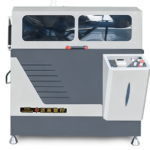
Automatic Aluminum Corner Connector Cutting Saw: Precision Automation for Modern Window Manufacturing
Table of Contents
Introduction

In aluminum door and window manufacturing, automatic aluminum corner connector cutting saws are small components, but they directly determine the structural strength, sealing performance, and assembly accuracy of the entire frame system. If your cutting process is unstable, everything downstream becomes unreliable: corner crimping fails, assembly gaps increase, and rework rates rise.
This is exactly why the automatic aluminum corner connector cutting saw has become one of the most important machines in modern fabrication workshops.
Unlike manual or semi-automatic cutting methods, automated systems deliver consistent precision, high-speed repetitive cutting, and stable production quality. Industry equipment data shows that automated cutting systems can reduce dimensional errors to within ±0.1 mm while significantly improving throughput efficiency in mass production environments.
In this article, you will explore how this machine works, why it is transforming production workflows, and how you can integrate it into your factory for higher efficiency and consistency.
What Is an Automatic Aluminum Corner Connector Cutting Saw?
An automatic aluminum corner connector cutting saw is a CNC-controlled or PLC-controlled machine designed specifically to cut aluminum corner connectors used in door and window systems.
It typically includes:
- Automatic feeding system
- Precision saw blade cutting unit
- Pneumatic or hydraulic clamping system
- Digital control interface
- Cooling and safety protection systems
The machine is designed so that you only load the material, set the cutting parameters, and let the system complete the entire process automatically.
Modern systems often use linear guide motion and servo-driven feeding mechanisms to ensure high repeatability and low resistance during operation.
Why Traditional Corner Cutting Methods Are No Longer Enough
Manual Cutting Inconsistency
Manual saw cutting depends heavily on operator skill. Even small variations in angle or pressure lead to inconsistent connector geometry.
Low Production Efficiency
Each cut requires repositioning and measurement, slowing down batch production.
High Material Waste
Incorrect cuts often cannot be reused, increasing scrap rates.
Poor Repeatability
Producing identical connectors for large projects becomes difficult without automation.
These issues become critical when you scale production or handle high-precision architectural projects.
How Automatic Aluminum Corner Connector Cutting Saw Works
Step 1: Automatic Feeding System
Profiles are loaded into the feeding unit. The system automatically positions each piece for cutting using linear guide rails.
Step 2: Precision Clamping
Pneumatic or hydraulic clamps secure the material to prevent movement during cutting.
Step 3: Controlled Cutting Process
A high-speed carbide saw blade performs precise cutting, often supported by hydro-pneumatic damping systems for smoother motion.
Step 4: Automatic Output and Counting
Finished parts are automatically released, and production data is recorded digitally.
Some advanced systems can even store cutting programs and resume operation after power interruption, improving production continuity .
Key Advantages You Can Expect
High Precision Cutting
Modern machines achieve cutting accuracy within tight tolerances, ensuring perfect fit during assembly.
Fully Automated Production
Once parameters are set, the system runs continuously with minimal operator intervention.
Stable Batch Quality
Every connector is identical, improving final product consistency.
Reduced Labor Dependency
One operator can manage multiple machines simultaneously.
Improved Safety
Closed protective covers and safety systems reduce operational risk.
Real Case: Improving Assembly Accuracy in a Window Workshop
A mid-sized aluminum fabrication workshop struggled with inconsistent corner connector quality. This led to:
- Frequent assembly misalignment
- Increased rework during frame assembly
- Higher material waste
After introducing an automatic aluminum corner connector cutting saw, the workshop observed:
- Significant improvement in cutting consistency
- Reduced assembly correction time
- Higher batch uniformity
- Faster order completion cycles
The biggest improvement came from eliminating manual measurement errors and standardizing cutting operations.
Key Features You Should Look For
1. Automatic Feeding System
Ensures smooth and continuous material processing without manual repositioning.
2. High-Precision Saw Blade System
Carbide blades with stable spindle support ensure clean, accurate cuts.
3. Pneumatic or Hydraulic Clamping
Prevents vibration and movement during cutting.
4. Intelligent Control Interface
Touchscreen PLC systems allow easy programming and monitoring.
5. Cooling and Dust Control
Spray cooling systems extend blade life and improve surface quality .
Comparison: Manual vs Automatic Cutting
| Feature | Manual Cutting | Automatic Corner Connector Cutting Saw |
|---|---|---|
| Accuracy | Medium | High |
| Speed | Low | High |
| Labor Requirement | High | Low |
| Repeatability | Poor | Excellent |
| Material Waste | Higher | Lower |
| Safety Level | Medium | High |
This comparison clearly shows why automation is becoming the industry standard.
How to Integrate It Into Your Production Line
Integration with Cutting Systems
Place the machine after profile extrusion or preparation stages for continuous workflow.
Integration with Assembly Lines
Accurate connectors improve downstream corner crimping quality.
Data-Based Production Control
Some systems can track cutting counts and integrate with production management systems.
Industry Insight: Why Automation Is Accelerating
According to industrial machinery reports, automatic aluminum corner connector cutting saw systems are being widely adopted due to increasing demand for:
- Custom window systems
- High-rise curtain wall projects
- Faster delivery cycles
Social media manufacturing communities also highlight that workshops adopting automation report improved consistency and reduced dependency on skilled labor.
Internal Resources You Can Explore
To better understand how this machine fits into a full production system, you can also explore:
- CNC Profile Bending Machine Guide: Precision Shaping for Modern Aluminium Manufacturing
- End Milling Machine Guide to Precision Door Manufacturing
- 5 Proven Benefits of Intelligent Door & Window Production Line
- 5 Proven Benefits of a Production Line for Doors and Windows
These systems often work together in a complete door and window production line.
Common Mistakes You Should Avoid
Ignoring Blade Maintenance
Worn blades reduce cutting precision and increase burr formation.
Improper Feeding Setup
Incorrect material alignment leads to dimensional deviation.
Skipping Calibration
Without regular calibration, accuracy gradually decreases.
Overloading Production Speed
Running beyond recommended speed can affect cutting stability.
Maintenance Tips for Long-Term Stability
- Clean saw blades regularly
- Check pneumatic system pressure
- Inspect feeding rails for wear
- Maintain cooling system performance
- Update control programs when needed
Proper maintenance ensures consistent performance and longer machine lifespan.
Conclusion
The automatic aluminum corner connector cutting saw is more than a cutting tool—it is a precision control system that directly impacts product quality, assembly efficiency, and production scalability.
By eliminating manual errors and standardizing output, you can significantly improve your workshop’s consistency and competitiveness.
If your goal is to upgrade from manual or semi-automatic processing to a stable, scalable production system, this machine is a critical step forward in that transformation.
FAQ
What is an automatic aluminum corner connector cutting saw used for?
It is used for precise cutting of aluminum corner connectors for doors and windows.
Is it suitable for mass production?
Yes, it is designed specifically for high-volume repetitive cutting.
How accurate is the cutting process?
Modern systems can achieve very high precision, typically within ±0.1mm depending on configuration.
Does it require skilled operators?
Basic training is enough due to automated controls.
Can it integrate with other machines?
Yes, it can be integrated into full aluminum door and window production lines.